Aurora borealis, an entrancing, dramatic, magical display that fascinates all who see it .
 |
| "Long exposure picture capturing northern lights and light pollution of the nearby town on the left. There is also a small glimpse of milky way on the top, but the best part is hidden under the horizon" , Thórsmörk, Iceland Credits to Jonatan Pie (instagram @r3dmax) |
An aurora (plural: auroras or aurorae),sometimes referred to as polar lights, northern lights (aurora borealis), or southern lights (aurora australis), is a natural light display in the Earth's sky, predominantly seen in the high-latitude regions (around the Arctic and Antarctic).
What causes the Aurora ?
Auroras are the result of disturbances in the magnetosphere caused by solar wind. These disturbances are sometimes strong enough to alter the trajectories of charged particles in both solar wind and magnetospheric plasma. These particles, mainly electrons and protons, precipitate into the upper atmosphere (thermosphere/exosphere). |
| timeanddate.com |
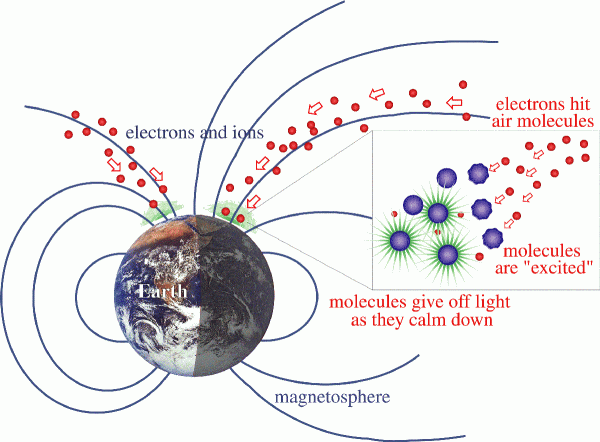 |
| When charged particles from the sun strike air molecules in Earth's magnetic field, they cause those molecules' atoms to become excited. The molecules give off light as they calm down. Image via NASA earthsky.org/ |
 |
| Aurora australis from the ISS, 2017 wikipedia |
What causes the colors?
The colors most often associated with the aurora borealis are pink, green, yellow, blue, violet, and occasionally orange and white. Typically, when the particles collide with oxygen, yellow and green are produced. Interactions with nitrogen produce red, violet, and occasionally blue colors.The type of collision also makes a difference to the colors that appear in the sky: atomic nitrogen causes blue displays, while molecular nitrogen results in purple. The colors are also affected by altitude. The green lights typically in areas appear up to 150 miles (241 km) high, red above 150 miles; blue usually appears at up to 60 miles (96.5 km); and purple and violet above 60 miles.
These lights may manifest as a static band of light, or, when the solar flares are particularly strong, as a dancing curtain of ever-changing color.

How are auroras formed animation/ Sarah Thompson Butler
Best Places to See Northern Lights
This auroral zone covers Central and northern Alaska and Canada, Greenland, northern Scandinavia and Russia in the Northern Hemisphere, and Antarctica in the Southern Hemisphere. In the south, auroras can sometimes be seen from southern Australia, New Zealand, and Chile.
On very rare occasions, auroral displays can be observed from locations close to the Equator. For instance, in 1909, because of a very strong geomagnetic storm, people in Singapore were able to observe auroral displays.
When's the Best Time to See Auroral Lights?
While auroral activity and auroras can occur throughout the year, day and night, the best time to view them is at night during the winter months. This is because, during the winter, areas around the North and the South Poles have longer periods of darkness.Auroras are best observed around midnight – when it is darkest – on a clear night, and at a location that is away from the city. Light sources – artificial or natural, like from a full Moon – can make it very hard to view the aurora.
Please check the following two links where you can find all these infos in a simplified way (image format) :
 NASA Pamphlet featuring many of JAN CURTIS photos
(NASA/ National Geographic Photographer)

 |
| Aurora in Yellow knife Canada Credits to Ken Cheung kencheungphoto.com |
 |
| Northern lights and Milky way near Tromsø - Norway Credits to Ludovic Charlet instagram.com/ludo.lyon |
 |
| Someroharju, FinlandCredits to Vincent Guth vingtcent.com |
No comments:
Post a Comment
feel free to leave an inquiry